Why aftercare determines your results
A beard transplant places delicate, newly implanted grafts into the skin, and in the days that follow, those grafts are at their most vulnerable. Good aftercare protects graft survival and directly affects how full and natural the final beard looks, while poor aftercare, picking, scratching, or skipping instructions, can affect graft survival and healing.
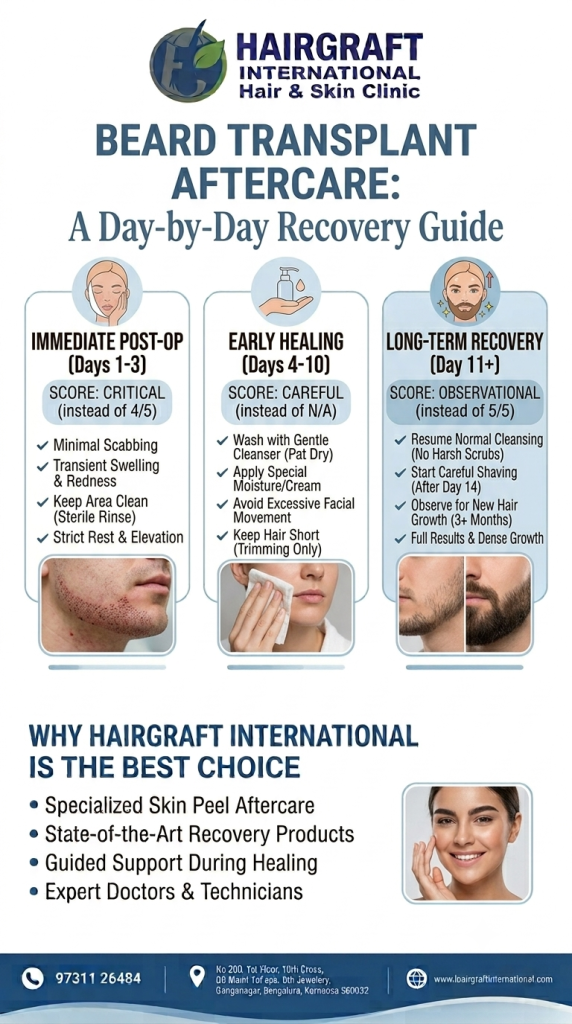
Immediately after the procedure
Right after your beard transplant, some redness, swelling and small scabs around each graft are normal. Your clinic will apply a light dressing or ointment to the treated area and give you specific instructions on when and how to first clean it.
Day-by-day beard transplant aftercare
Day 1:
- Avoid touching the transplanted area
- Sleep with your head slightly elevated if advised, to reduce swelling
- Avoid alcohol and smoking, both can affect healing
- Take any prescribed medication as directed
Day 2 to 3:
- Gentle cleaning of the area usually begins around this point, exactly as instructed by your clinic, using a mild, recommended cleanser
- Avoid rubbing or scrubbing; cleaning is typically done with a gentle patting or dabbing motion
- Mild swelling may peak around this time before it starts to settle
Day 4 to 7:
- Small scabs form around each graft; do not pick, scratch or scrub them off
- Continue gentle cleaning as instructed
- Avoid direct sun exposure on the treated area
- Avoid tight clothing or anything that might rub against the beard area
Week 2:
- Most scabs naturally flake off by this stage
- Some redness may still be present, this is normal and continues to fade
- Avoid shaving until your clinic confirms it’s safe
Week 2 to 4:
- It’s completely normal for the transplanted hairs to shed during this period, called shock loss. This does not mean the transplant has failed, the follicle remains and will regrow later
- Continue sun protection on the area
Month 2 to 3:
- New hair growth typically begins around this time
- Growth starts fine and sparse before thickening over the following months
Month 6 to 12:
- Beard fills in progressively, with texture and thickness continuing to improve
- Full results are typically visible by month 9 to 12
What to avoid during recovery
- Touching, scratching or picking at the grafts or scabs
- Direct sun exposure on the treated area without protection, especially in the first few weeks
- Shaving or trimming until your clinic confirms it’s safe, usually not before a few weeks have passed
- Swimming pools, saunas or steam rooms, until the area is fully healed
- Strenuous exercise that causes heavy sweating, for the first week or so, since sweat can irritate healing grafts
- Alcohol and smoking, both can slow healing and affect graft survival
Sleeping and daily habits during recovery
- Avoid sleeping face-down or pressing your face into a pillow during the first several nights
- Be gentle when washing your face; pat rather than rub
- Avoid applying skincare products, aftershave or cosmetics to the area until cleared by your clinic
Managing shock loss without worry
Shedding of the transplanted hairs between weeks 2 and 4 often causes concern, since it can look like the procedure hasn’t worked. This is a normal, expected phase. The hair follicle itself stays in place beneath the skin and re-enters a new growth cycle, with visible regrowth typically starting around month 2 to 3.
Signs to contact your clinic
- Increasing redness, swelling or pain beyond the first few days
- Signs of infection: pus, warmth, or fever
- Grafts that appear to be falling out along with visible bleeding beyond the initial recovery period
- Any concern that doesn’t match what you were told to expect
It’s always better to check in with your clinic than to wait and hope a concerning symptom resolves on its own.
A realistic recovery timeline at a glance
| Timeframe | What to expect |
|---|---|
| Day 1-3 | Redness, mild swelling, scabbing begins |
| Day 4-7 | Scabs present, gentle cleaning continues |
| Week 2 | Scabs flake off naturally |
| Week 2-4 | Shock loss (transplanted hair sheds) |
| Month 2-3 | New growth begins |
| Month 6-12 | Beard fills in, full results visible |
Honest expectations
Beard transplant results build gradually over months, not weeks, and following aftercare instructions closely in the first few weeks has a real impact on how well the grafts settle and grow. Rushing back to shaving, sun exposure or heavy activity too early can affect the final result.
Frequently asked questions
When can I shave after a beard transplant?
Only once your clinic confirms it’s safe, typically not before a few weeks, since shaving too early can disturb healing grafts.
Is shock loss normal?
Yes, it’s a normal part of the process. The hair follicle remains in place and regrows later.
How long until I see full results?
Most patients see full results between 9 and 12 months after the procedure.
Can I exercise after a beard transplant?
Light activity is usually fine after the first couple of days, but strenuous exercise that causes heavy sweating should be avoided for about a week, or as advised by your clinic.
What if a scab falls off early?
Avoid picking at it yourself. If a scab comes off naturally, keep the area clean and gently moisturised as instructed, and don’t be alarmed, if it happens on its own rather than by picking, it’s usually a normal part of healing.
Book a consultation
A successful beard transplant depends on more than the procedure itself, careful aftercare plays a major role in the final result. Book a consultation with the doctors at Hairgraft International to get a personalised aftercare plan alongside your procedure.