Why eyebrows matter more than people realise
Eyebrows frame the face and shape expression far more than most people give them credit for. When they’re thin, patchy or uneven, whether from over-plucking, ageing, alopecia, genetics or a scar, it can change how a face reads, even subtly. Eyebrow transplant is a surgical way to permanently rebuild natural brow density using your own hair.
What is an eyebrow transplant?
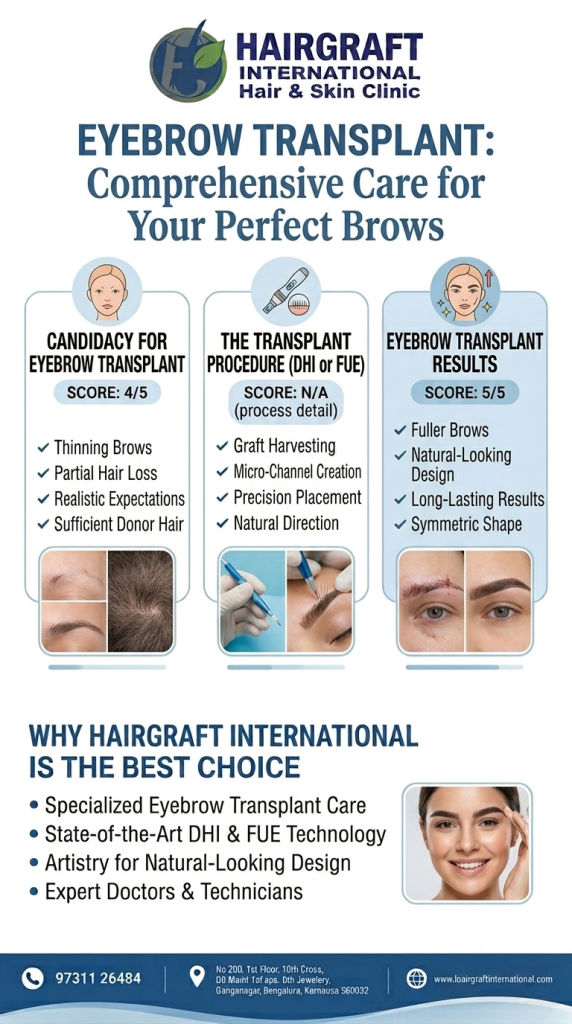
An eyebrow transplant moves individual hair follicles, usually taken from the scalp, into the brow area to restore density, shape and coverage. Unlike makeup, microblading or brow pencils, the result is real, growing hair.
Common causes of thin or patchy eyebrows
- Over-plucking or waxing over the years, which can permanently damage follicles
- Genetics, some people are simply born with sparse brows
- Ageing, brow density naturally reduces over time
- Alopecia areata, an autoimmune condition that can cause patchy hair loss, including eyebrows
- Scarring, from injury, burns or previous surgery
- Trichotillomania, a hair-pulling disorder that can permanently thin the brow over time
Since some causes are temporary or medically treatable and others are permanent, diagnosis matters before deciding on a transplant, the same principle that applies to any hair restoration procedure.
How the eyebrow transplant procedure is done
- Consultation and brow design: the doctor examines your natural brow shape, face structure and goals, and designs a brow shape that suits your face rather than a generic template.
- Donor hair selection: hair is usually taken from the scalp, most often from behind the ear or the nape, since these areas tend to grow finer hair that blends better with natural brow hair.
- Local anaesthesia: both the donor area and the brow area are numbed.
- Extraction: individual follicular units are removed one at a time using FUE.
- Recipient site creation: this is the most delicate part of the procedure. Because eyebrow hair grows at a very shallow angle and in specific directions (fanning outward and slightly upward at the tail), each incision has to match this natural direction precisely.
- Implantation: grafts are placed one by one, following the natural growth pattern to avoid a “pasted-on” look.
- Aftercare: instructions on cleaning, avoiding touching the area, and follow-up visits.
Why eyebrow direction matters so much
Eyebrow hair doesn’t grow in one uniform direction the way scalp hair often does. Near the inner corner, hair usually grows upward. In the middle, it angles outward. At the tail, it slants downward. Getting this wrong is the most common reason eyebrow transplants look unnatural, which is why this procedure typically takes more precision and time per graft than a scalp transplant, even though far fewer grafts are used overall.
Who is a good candidate?
- People with thin, patchy or over-plucked eyebrows that haven’t recovered on their own
- People with eyebrow loss from scarring or old injury
- People with stable alopecia-related brow loss, confirmed by a dermatologist
- Anyone with enough donor hair, usually from the scalp, to support the transplant
Who may not be a good candidate
- Active alopecia areata that hasn’t stabilised, since new patches of loss could appear after the transplant
- Trichotillomania that is still active, since the urge to pull hair could affect the transplanted follicles too
- Insufficient donor hair
Recovery timeline
- First few days: mild redness, swelling and small scabs around the brow area are normal.
- Week 1 to 2: scabs flake off on their own; scratching or picking should be avoided.
- Week 2 to 4: the transplanted hairs shed, a normal part of the process called shock loss, not a sign of failure.
- Month 3 to 4: new growth begins.
- Month 8 to 12: full results are typically visible, with the transplanted brow hair matching in density and direction.
A quirk worth knowing: brow hair keeps growing
Because eyebrow transplants often use scalp hair, and scalp hair grows much faster and longer than natural brow hair, the transplanted hairs will need regular trimming to keep them at eyebrow length. This is a normal, expected part of aftercare, not a complication.
Honest expectations
An eyebrow transplant gives a permanent increase in density and can rebuild a natural shape, but it’s a precise procedure that depends heavily on the surgeon’s skill in replicating natural hair direction. Results also depend on your donor hair’s texture, since finer scalp hair blends more naturally into brows than coarser hair. Realistic expectations, discussed clearly at consultation, matter more here than in almost any other hair transplant procedure.
Eyebrow transplant vs microblading
| Eyebrow transplant | Microblading | |
|---|---|---|
| What it is | Real, growing hair | Semi-permanent pigment/tattoo |
| Permanence | Permanent | Fades over 1-2 years |
| Maintenance | Occasional trimming | Regular touch-ups |
| Feel | Natural hair | Pigment only, no texture |
Some patients choose microblading as a short-term option while deciding on a transplant, or combine the two temporarily during the growth period.
Frequently asked questions
Is eyebrow transplant painful?
The area is numbed with local anaesthesia, so most patients feel only mild discomfort during the procedure.
How many grafts are needed?
This varies by individual, but eyebrows typically need far fewer grafts than a scalp transplant, since the area is small.
Will the eyebrows need trimming?
Yes, if scalp hair is used as the donor source, since it grows faster and longer than natural brow hair.
How soon will I see results?
New growth begins around month 3 to 4, with full results by month 8 to 12.
Can both eyebrows be treated in one session?
Yes, both eyebrows are typically treated together in a single session.
Book a consultation
A natural-looking eyebrow transplant depends on precise planning and an experienced hand. Book a consultation with the doctors at Hairgraft International to find out if it’s the right option for you.