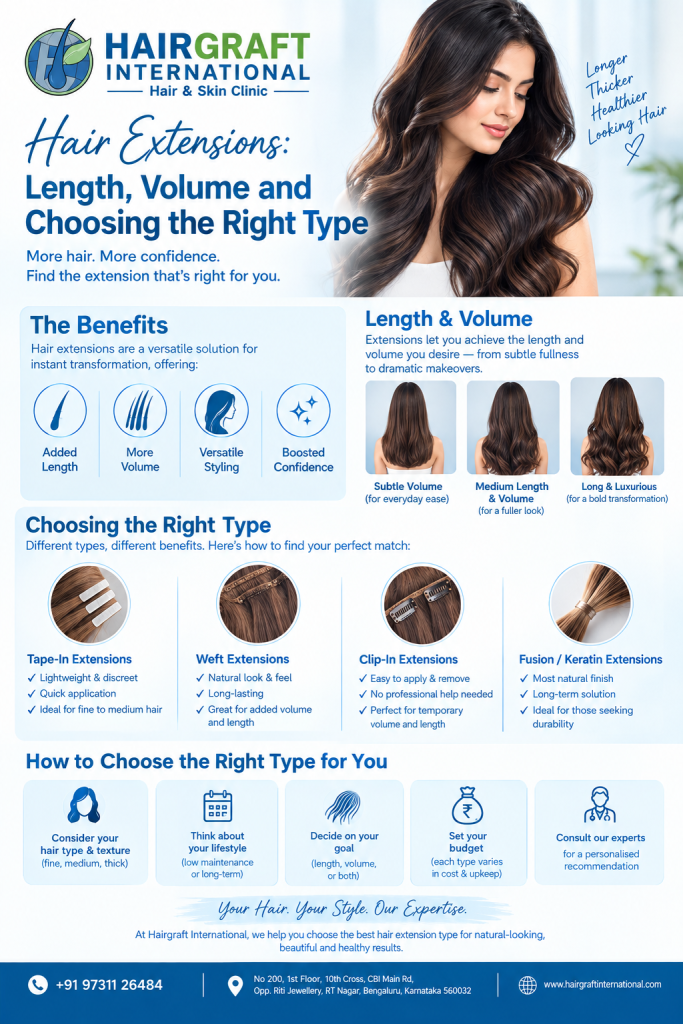
Hair extensions are one of the fastest ways to change your look without surgery or downtime. They can add length, fullness or thickness in a single visit. But there are several types, and the wrong one can strain your natural hair. This guide explains how extensions work, how they’re fitted, and how to choose.
What are hair extensions?
Hair extensions are strands or wefts of natural or synthetic hair attached to your own hair. They blend with your natural hair to add length, volume or coverage over thin areas.
Why are hair extensions done?
- To add length quickly
- To add volume and thickness to fine or thin hair
- To camouflage areas where hair is sparse
- To try a new colour or highlights without dyeing your own hair
- To get a fuller look for events, without a long-term commitment
Types of hair extensions
| Type | How it’s attached | Wear | Suits |
|---|---|---|---|
| Clip-in | Clips you fasten yourself | Removed daily | Occasional use, first-timers |
| Tape-in | Thin adhesive tape sandwiches your hair | Semi-permanent | Adding volume with a flat, light feel |
| Micro-ring (micro-link) | Tiny rings or beads crimp small sections | Long-wear | Length and fullness without glue or heat |
| Sewn-in (weft) | Weft stitched onto a braid | Long-wear | Thicker hair that can hold a braid |
| Bonded (keratin) | Keratin bond attached to small sections | Long-wear | Natural movement |
Extensions can be made of human hair (which can be styled and coloured more like your own) or synthetic hair (cheaper, but less flexible with heat and colour). The doctor or stylist will recommend what suits your hair type and lifestyle.
How the procedure is done
- Consultation: your hair, scalp and goals are assessed. If you have thinning for a medical reason, this is the time to find out why.
- Matching: colour, texture and length are matched to your natural hair.
- Sectioning: your hair is divided into neat sections for placement.
- Attachment: extensions are fitted with the method chosen, whether clip, tape, ring, weft or bond.
- Blending and styling: the ends are trimmed and blended so your natural hair and the extensions look like one.
- Aftercare briefing: you’re shown how to wash, brush and sleep with them.
Who are extensions best suited for?
- People with healthy hair who want extra length or volume
- Those who want a temporary, non-surgical change
- People who want to cover mild thinning while they explore longer-term treatment
Caring for hair extensions
- Brush gently, starting from the ends and moving up
- Use sulphate-free, mild shampoo and avoid applying conditioner to the attachment points
- Avoid high heat near the bonds or tapes
- Tie hair loosely at night to prevent tangling
- Come in for re-fitting or moving-up when advised, since attachments shift as your hair grows
Risks and honest expectations
- Traction and breakage: heavy extensions, or ones fitted too tightly, put strain on your natural hair and can cause breakage or traction hair loss over time.
- Scalp irritation: adhesives and attachments can irritate sensitive scalps, so mention any allergies at consultation.
- They don’t treat hair loss: extensions disguise thinning, they don’t stop it. If your hair is falling out or thinning, the cause should be diagnosed first.
- Maintenance: long-wear types need regular re-fitting and replacement.
Extensions vs other options
| Option | Grows your own hair? | Surgery? |
|---|---|---|
| Hair extensions | No | No |
| Hair fixing / bonding | No | No |
| PRP / GFC therapy | Supports existing hair | No |
| Hair transplant | Yes | Yes |
If you want a permanent, natural result, a transplant is the option that grows your own hair. Extensions are best when you want a quick, reversible change.
Frequently asked questions
Do hair extensions damage your natural hair?
They don’t have to, if they’re the right weight and properly fitted and maintained. Heavy or tight extensions can cause breakage or traction loss.
How long do extensions last?
It depends on the type. Clip-ins are removed daily. Semi-permanent and long-wear types typically need re-fitting every few weeks to months.
Can I use extensions if my hair is thinning?
Sometimes, but thin, weak hair may not support heavy extensions. Get the cause of thinning checked first.
Can I wash and style extensions?
Yes, with care. Follow the aftercare instructions for your type.
Book a consultation
The right type depends on your hair, your scalp and what you want to achieve. Book a consultation with the team at Hairgraft International to find the option that suits you.