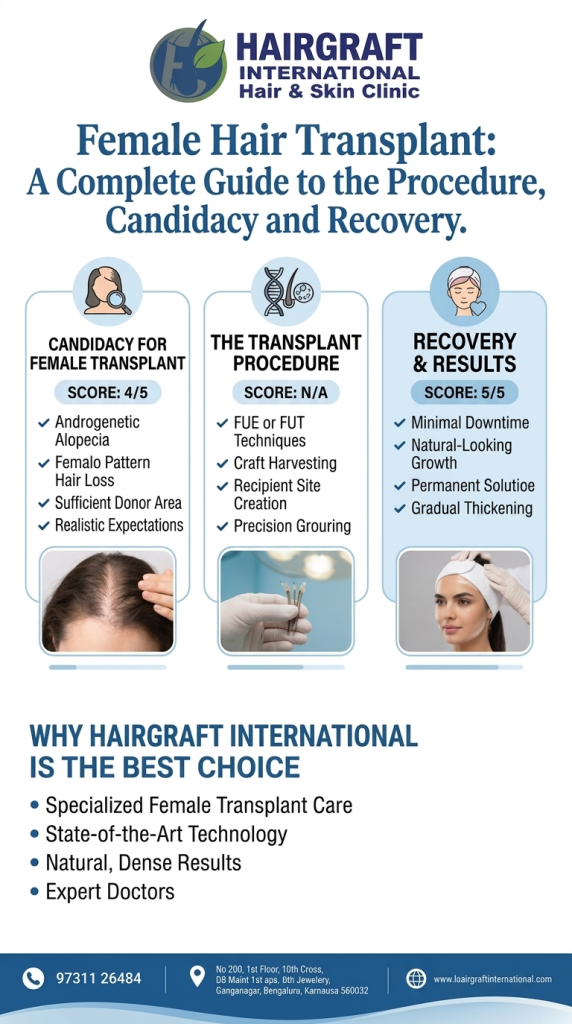
Hair loss in women is far more common than most people realise, yet it rarely gets the same open conversation that male baldness does. Many women suffer silently, trying scarves, styling tricks or concealer powders to hide thinning patches, before ever consulting a doctor. The good news is that surgical hair restoration has advanced enough that many women with stable, well-diagnosed hair loss can achieve genuinely natural, long-lasting results.
This guide walks through everything worth knowing before considering a female hair transplant: why female hair loss behaves differently from male pattern baldness, how the surgery is planned and performed, who actually qualifies, what recovery looks like, and what questions to ask at your consultation.
Understanding Female Hair Loss First
Before talking about surgery, it helps to understand why women lose hair in the first place, because the cause directly decides whether a transplant will actually work.
Common causes of hair loss in women
- Female pattern hair loss (androgenetic alopecia): the most common cause, usually appearing as diffuse thinning at the crown and along the parting, with a widening centre part. Unlike men, most women retain their frontal hairline.
- Postpartum shedding (telogen effluvium): temporary, heavy shedding a few months after childbirth, usually caused by hormonal shifts. This typically resolves on its own without surgery.
- Traction alopecia: gradual hair loss from years of tight hairstyles, braids, weaves or extensions pulling at the roots, most visible along the hairline and temples.
- Hormonal and thyroid-related hair loss: conditions such as PCOS, thyroid imbalance or hormonal changes around menopause can cause diffuse thinning.
- Nutritional deficiencies: low iron, vitamin D or protein intake can accelerate shedding.
- Scarring alopecia: hair loss following surgery, burns, injury or certain autoimmune skin conditions, where the follicles themselves have been damaged or destroyed.
- Stress-related shedding: significant physical or emotional stress can trigger a temporary shedding phase.
Some of these causes are permanent and structural (like female pattern hair loss or scarring alopecia), which can be corrected surgically. Others are temporary and reversible (like postpartum shedding or a nutritional deficiency), where surgery is not the right first step, and treating the underlying cause usually resolves the shedding on its own.
This is the single most important distinction in female hair restoration: surgery works well for permanent, localised follicle loss, but it cannot fix an ongoing or reversible cause of shedding. A responsible clinic will always diagnose before recommending an operation.
Why Female Hair Transplant Is Approached Differently From Male Hair Transplant
Men typically lose hair in a predictable pattern: a receding hairline, thinning crown, or both, following the well-documented Norwood scale. This makes male hair loss relatively straightforward to plan around, because the donor area (back and sides of the scalp) is usually stable and untouched by the balding process.
Women’s hair loss usually doesn’t follow this pattern. Instead of a receding hairline, most women experience diffuse thinning spread across the scalp, often most visible at the crown and along the centre parting, while the frontal hairline stays largely intact. In some cases, the donor area itself, which is normally protected from hair loss, may also show some thinning.
This changes the entire approach to surgery in several ways:
- Donor hair evaluation is more critical. The surgeon has to confirm there’s genuinely enough healthy, stable hair in the donor zone to harvest from, since diffuse thinning can sometimes affect areas that would otherwise be considered “safe” donor zones.
- The diagnosis stage takes longer. Because so many causes of female hair loss are treatable without surgery, ruling those out first is essential.
- Technique and aesthetic goals differ. Women are less likely to want a fully shaved head, and rebuilding density along a parting requires a different pattern of graft placement than rebuilding a hairline.
- Combination treatment is more common. Because hormonal and nutritional factors often play a role, transplant surgery is frequently combined with medical management, rather than used as a standalone fix.
Diagnosis: The Step That Happens Before Any Surgical Plan
No credible clinic should recommend a transplant to a woman without first understanding why she is losing hair. The diagnostic process typically includes:
- A detailed scalp and hair examination, checking the pattern, density and distribution of thinning
- Pull tests and scalp analysis, to assess how active the shedding currently is
- Blood tests, to check thyroid function, iron levels (ferritin), vitamin D, and hormonal markers, especially if PCOS or menopause-related changes are suspected
- A review of hairstyling history, since years of tight braids, weaves or extensions can point to traction alopecia
- A review of medical and family history, including any autoimmune conditions or a family history of pattern hair loss
Only once the cause is identified, and the doctor confirms the hair loss is stable rather than actively progressing, does a surgical plan get discussed. If the cause turns out to be temporary or medically treatable, the right path is treatment first, not surgery.
How the Female Hair Transplant Procedure Is Done
Once a woman is confirmed as a suitable candidate, the procedure itself follows a structured process:
Step 1: Consultation and planning
The surgeon maps out the areas of thinning, decides how many grafts will realistically be needed, and plans the direction and pattern of graft placement to match natural hair growth, particularly important around a parting, where hair lies in a very specific direction.
Step 2: Donor area evaluation
The back and sides of the scalp are examined closely to confirm density and health. Because women often prefer not to have a fully shaved head, the surgeon will typically plan for a partial-shave or unshaven (long hair) FUE technique, where only a small, easily concealed strip or scattered sections of the donor area are trimmed.
Step 3: Local anaesthesia
The donor and treatment areas are numbed with local anaesthesia so the procedure is comfortable throughout.
Step 4: Graft extraction (FUE)
Follicular Unit Extraction is the technique most commonly used for women, since it doesn’t leave a linear scar and suits the unshaven approach. Individual follicular units are removed one at a time from the donor zone using a fine micro-punch.
Step 5: Recipient site creation
Tiny incisions are made in the thinning areas, angled and directioned to match the natural flow of existing hair. This step is especially delicate around the parting and crown, where even small errors in angle can look unnatural.
Step 6: Graft implantation
Grafts are placed into the recipient sites, usually working from areas of greatest need outward, to rebuild density gradually and naturally rather than in an obviously “patched” pattern.
Step 7: Aftercare instructions
Patients are given detailed instructions on washing, sleeping position, medication (if prescrib2ed) and activity restrictions, along with a schedule for follow-up visits.
The full procedure typically takes several hours, depending on the number of grafts needed, and is done on an outpatient basis, meaning patients go home the same day.
Techniques Used in Female Hair Transplant
- FUE (Follicular Unit Extraction): the most common choice for women, since it avoids a linear scar and works well with the unshaven technique.
- Unshaven / partial-shave FUE: hair length is preserved in the donor area, either by trimming very short, easily hidden sections or by carefully extracting grafts without a full shave, so the patient can return to normal activities without an obvious post-surgery look.
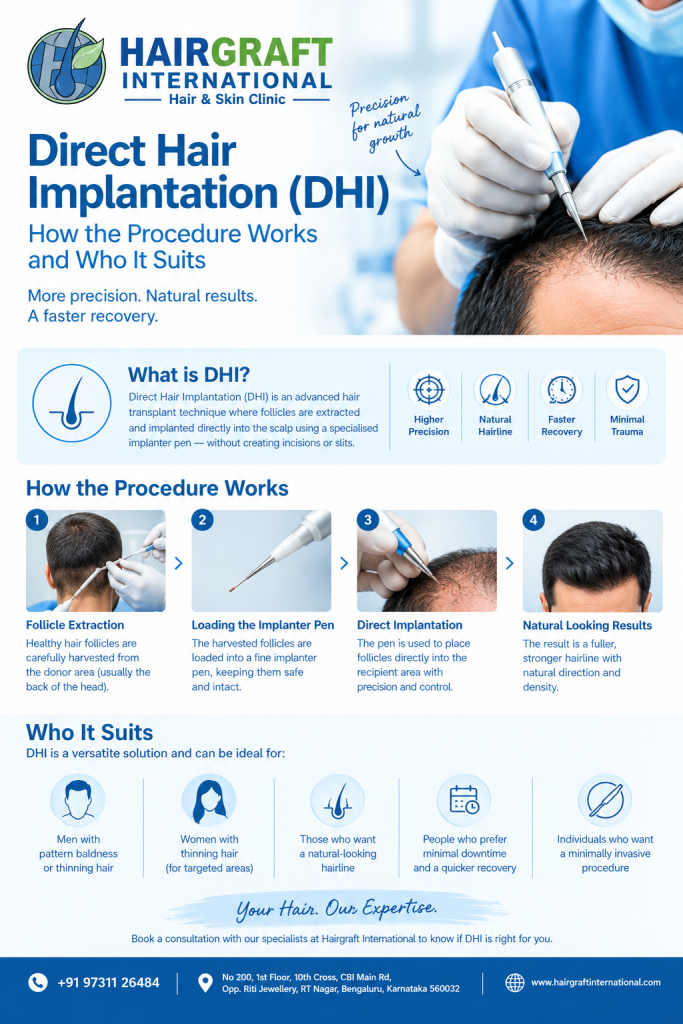
- DHI (Direct Hair Implantation): sometimes used for precise density-building along the parting or hairline, since it allows fine control over graft angle and placement.
The choice between these depends on the pattern of loss, donor availability and the patient’s own preference, and is finalised at consultation.
Who Is a Good Candidate for Female Hair Transplant?
- Women with stable, non-progressive thinning, confirmed through diagnosis
- Women with a localised pattern of loss, such as a receding or uneven hairline, or thinning limited to a specific zone
- Women with scarring hair loss from injury, past surgery or traction alopecia, where the affected area is well-defined
- Women who have enough healthy, dense donor hair to support the number of grafts needed
Who May Not Be a Good Candidate
- Women with widespread, diffuse thinning across the entire scalp, including the donor zone, since there may not be enough healthy hair to safely harvest
- Women whose hair loss is still actively progressing and hasn’t stabilised
- Women whose hair loss stems from a treatable medical cause (thyroid, hormonal imbalance, nutritional deficiency) that hasn’t yet been addressed
- Women with certain active scalp conditions or autoimmune hair loss (such as active alopecia areata), where surgery may not hold long-term results
For these patients, the right first step is medical treatment, not surgery, and a transplant may be reconsidered later if the condition stabilises.
Recovery Timeline
- Day 1 to 3: mild swelling, redness and tenderness in both the donor and recipient areas. Most patients can return to light daily activity within a couple of days.
- Week 1 to 2: small scabs form around the grafts and gradually flake off. Gentle washing is usually permitted a few days after surgery, following the clinic’s specific instructions.
- Week 2 to 4: it’s completely normal for the transplanted hairs to shed. This is called “shock loss” and does not mean the transplant has failed, it’s simply the graft entering a resting phase before regrowth.
- Month 3 to 4: new hair growth typically begins.
- Month 6 to 9: visible thickening and improved density.
- Month 9 to 12: full results are generally visible, with the transplanted hair matching the surrounding hair in texture and growth pattern.
Recovery timelines vary from person to person depending on scalp health, the technique used and how well aftercare instructions are followed.
Costs and What Affects Pricing
Female hair transplant costs typically depend on:
- The number of grafts required
- The technique used (FUE, DHI, or a combination)
- Whether additional therapies (like PRP or GFC) are included in the plan
- The extent and pattern of thinning being treated
Because every case is different, an accurate cost estimate can only be given after an in-person consultation and scalp assessment.
Honest Expectations
A transplant restores density where follicles have already been lost, but it is not a cure for an ongoing cause of hair loss. If the underlying cause, whether hormonal, nutritional or otherwise, isn’t managed, further thinning can continue in untreated areas even after a successful transplant. For this reason, many women combine surgery with:
- Medical management of the underlying cause (thyroid treatment, iron supplementation, hormonal therapy where relevant)
- PRP (Platelet-Rich Plasma) or GFC (Growth Factor Concentrate) therapy, to support the health of existing hair alongside the transplanted grafts
- Ongoing scalp care, to maintain results long-term
Setting realistic expectations at the outset, both about what a transplant can achieve and what it can’t, leads to far better satisfaction with the outcome.
Questions Worth Asking at Your Consultation
- What is the specific cause of my hair loss, and how was it diagnosed?
- Is my hair loss stable, or is it still progressing?
- How much donor hair do I realistically have, and is it enough?
- Which technique (FUE, DHI, unshaven approach) is being recommended for me, and why?
- How many grafts will I likely need?
- What results are realistic for my specific case?
- Will I need any additional treatment alongside surgery?
A good clinic will answer these clearly and won’t push you toward surgery before the cause of your hair loss has been properly established.
Frequently Asked Questions
Do I need to shave my head for a female hair transplant?
Not always. A partial-shave or unshaven technique is often possible, and the extent depends on the areas being treated and the number of grafts needed. This is decided individually at consultation.
Is female hair transplant different from male hair transplant?
The core surgical technique (usually FUE) is similar, but the planning differs significantly. Female hair loss is more often diffuse rather than a receding hairline, so diagnosis, donor evaluation and graft placement patterns require a different approach.
Will the results look natural?
Yes, when grafts are placed to match the natural direction, angle and density of your existing hair, particularly important along a parting, where hair lies in a specific direction.
How do I know if I’m a candidate?
Only an in-person consultation, including a scalp examination and often blood tests, can confirm this. Self-diagnosis based on symptoms alone isn’t reliable, since several causes of female hair loss look similar on the surface but need very different treatment.
Is the procedure painful?
The area is numbed with local anaesthesia, so most patients report only mild discomfort during and after the procedure, manageable with prescribed medication.
Can I go back to work right after?
Most women return to normal daily activities within a few days, though strenuous exercise and activities that cause sweating are usually avoided for a short period as advised by the surgeon.
What if my hair loss is due to my thyroid or PCOS?
These conditions need to be medically managed first. Once your hair loss is stable, a transplant can be considered for any permanent thinning that remains.
Book a Consultation
Every woman’s hair loss story is different, and the right plan starts with an accurate diagnosis, not a one-size-fits-all recommendation. Book a consultation with the doctors at Hairgraft International for a proper scalp assessment and an honest opinion on whether a transplant is right for you.