Anyone researching hair transplants for more than a few minutes runs into the same three acronyms over and over: DHI, FUE, and FUT. Nearly every clinic offers at least one of these, many offer two, and some offer all three, often with conflicting opinions about which is “best.” The truth is that none of these techniques is universally superior to the others. Each was developed to solve slightly different problems, each comes with real trade-offs, and the right choice depends heavily on your specific hair loss pattern, donor supply, lifestyle, and goals. This guide breaks down exactly how each technique works, how they compare across the factors that actually matter, and how to think about which one fits your situation.
Why There Are Multiple Techniques in the First Place
Hair transplantation as a field has evolved considerably since its earliest days, when surgeons transplanted larger clumps of skin and hair that often produced an unnatural, “pluggy” appearance. Modern techniques all share the same underlying principle: moving individual hair follicles, or small natural groupings of follicles called follicular units, from a donor area with genetically resistant hair to areas experiencing thinning or baldness. Where they differ is in how those follicles are extracted from the donor area and how they’re placed into the recipient area.
FUT was the dominant technique for years before FUE became widely adopted, and DHI is a more recent refinement of the FUE extraction method with a different implantation approach. Understanding these differences in extraction and implantation is the key to understanding why each technique has genuinely different strengths, rather than one simply being an “upgraded” version of another.
FUT: Follicular Unit Transplantation
FUT, sometimes still referred to by its older name, the “strip method,” involves surgically removing a thin strip of scalp, typically from the back of the head where hair is most resistant to balding, under local anesthesia. This strip is then divided under microscopic magnification into hundreds or thousands of individual follicular units, which are then implanted into the recipient area one at a time.
How it works. After the strip is removed, the donor area is closed with sutures or staples, leaving a thin linear scar that’s typically hidden by surrounding hair, provided hair in that area is kept at a reasonable length going forward. The strip is dissected into individual grafts by a team of technicians under microscopes, a labor-intensive process that requires significant skill to avoid damaging the follicles.
Advantages. FUT typically allows for a higher number of grafts to be harvested and transplanted in a single session compared to FUE, since the strip method is generally faster for the extraction phase itself. It’s also often more affordable per graft than FUE or DHI, since the dissection process, while labor-intensive, doesn’t require the same specialized punch tools and extended procedure time that follicle-by-follicle extraction demands.
Disadvantages. The most significant drawback of FUT is the linear scar left at the donor site. While this is usually well hidden by surrounding hair, it does mean patients who prefer to keep their hair very short, buzzed, or shaved need to think carefully about this trade-off, since the scar can become visible at very short lengths. Recovery from the donor site also tends to take somewhat longer than FUE, given that it involves an incision and sutures rather than small individual extraction points.
FUE: Follicular Unit Extraction
FUE emerged as an alternative to FUT specifically to address the scarring concern, and it has become the most widely offered technique across clinics today. Rather than removing a strip of scalp, FUE involves extracting individual follicular units directly from the donor area using a small circular punch tool, one follicle group at a time.
How it works. A specialized punch, ranging from under 1mm in some cases, is used to make a small circular incision around each follicular unit, which is then extracted individually. This process is repeated hundreds or thousands of times to gather enough grafts for the session, and the extracted grafts are then implanted into the recipient area, similarly to FUT.
Advantages. Because each extraction leaves only a tiny, dot-like mark rather than a linear incision, FUE doesn’t produce a visible linear scar, and any small marks left behind are far less noticeable even at short hair lengths. This makes FUE particularly appealing to patients who like to keep their hair very short or shaved. Recovery time for the donor area also tends to be faster and less uncomfortable than FUT, since there’s no incision or sutures involved.
Disadvantages. FUE is a more time-intensive procedure for the surgical team, since each follicular unit must be individually identified and extracted, which generally means it takes longer to harvest large numbers of grafts compared to FUT. This often translates to a higher cost per graft. In very large sessions requiring thousands of grafts, FUE can sometimes result in slightly more graft transection (accidental damage during extraction) if performed by a less experienced team, though skilled surgeons using quality equipment keep this risk low.
DHI: Direct Hair Implantation
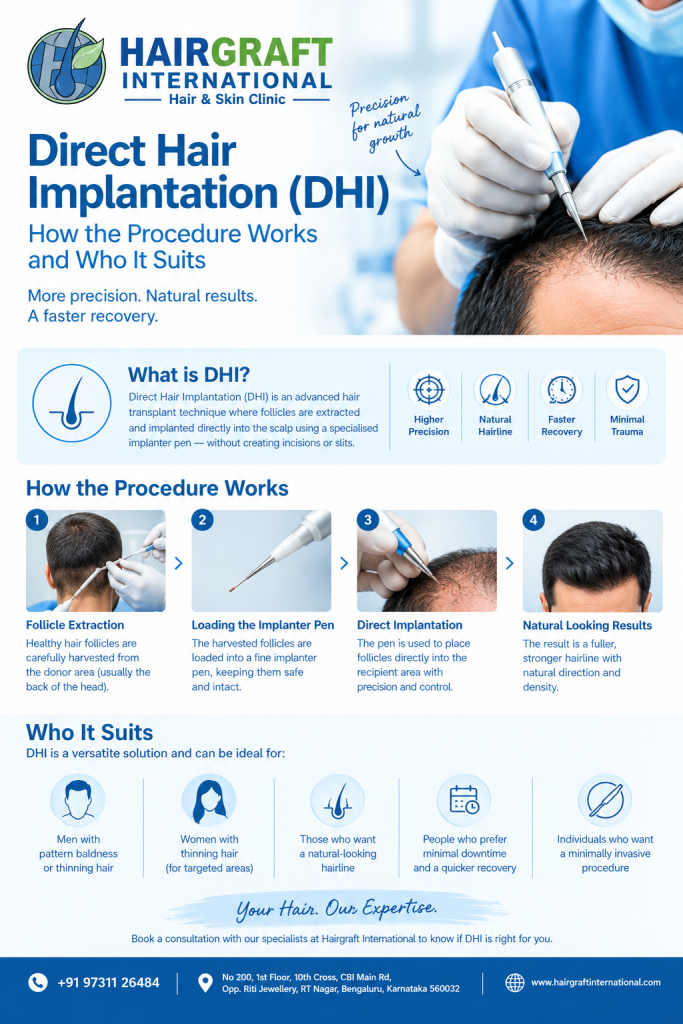
DHI is often described as a refinement or variation of FUE, since it uses a similar extraction method, but it differs meaningfully in how the grafts are implanted into the recipient area, which is where its distinct advantages and trade-offs come from.
How it works. Follicles are extracted using the same punch-based approach as standard FUE. The key difference is in implantation: rather than first creating recipient site incisions and then manually placing each graft into them (as in traditional FUE and FUT), DHI uses a specialized pen-like tool, often called a Choi implanter pen, that allows the surgeon to extract and implant each follicle in a single, more controlled motion, directly setting the angle, depth, and direction of each graft as it’s placed.
Advantages. Because the implanter pen allows for more precise control over the angle and depth of each graft at the moment of placement, many surgeons who specialize in DHI report being able to achieve higher graft density in certain areas and more natural-looking hair direction, particularly around delicate zones like the hairline. Since recipient sites aren’t pre-made as separate incisions, DHI can also reduce the time grafts spend outside the body (“out-of-body time”), which some studies suggest may improve graft survival rates.
Disadvantages. DHI is generally the most time-consuming and technically demanding of the three techniques, since it requires a highly skilled team working with specialized tools throughout the entire procedure. This typically makes it the most expensive option per graft. It’s also generally less suited to very large sessions requiring extremely high graft counts in a single sitting, since the implantation process is inherently slower than placing pre-extracted grafts into pre-made recipient sites.
Side-by-Side Comparison
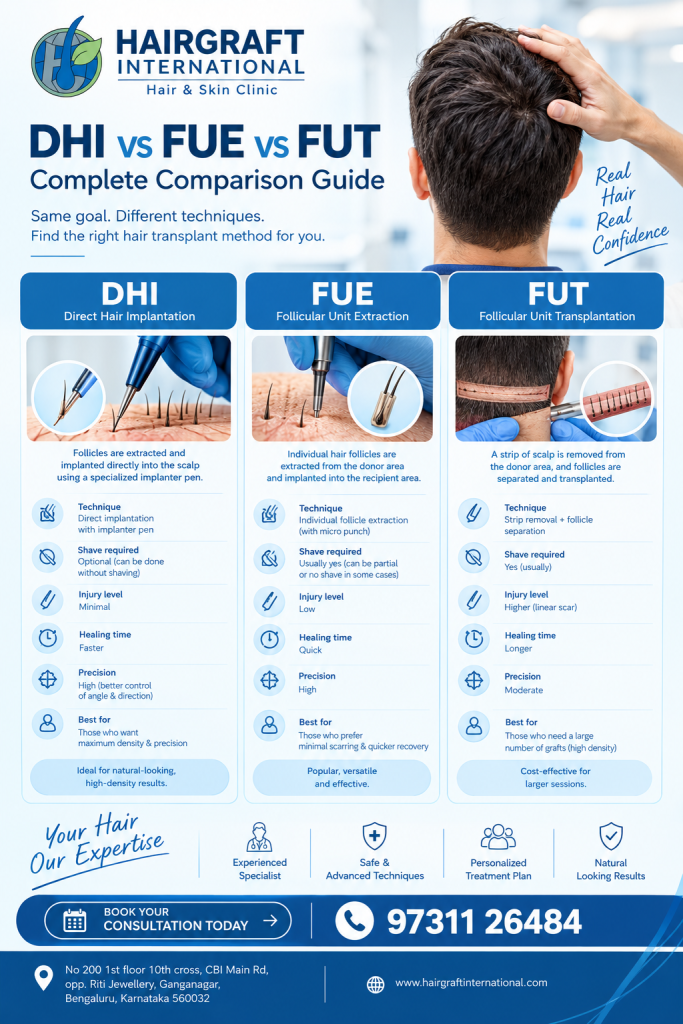
Donor site scarring. FUT leaves a linear scar, typically well hidden by surrounding hair. FUE and DHI both leave only small, dot-like marks that are far less noticeable, even at short hair lengths.
Recovery time. FUT generally has the longest donor-site recovery due to the incision and sutures. FUE and DHI both tend to have faster, more comfortable donor-site healing.
Graft capacity per session. FUT generally allows for the highest graft counts in a single session. FUE can also achieve large sessions but typically takes longer. DHI is generally best suited to small to moderate sessions given its slower implantation process.
Precision and control. DHI generally offers the most precise control over graft angle, depth, and direction at the point of implantation. FUE offers good precision with skilled hands. FUT’s precision depends heavily on the dissection team’s skill during strip processing.
Cost. FUT is typically the most affordable per graft. FUE sits in the middle. DHI is generally the most expensive due to the specialized tools and extended procedure time required.
Best suited for short hairstyles. FUE and DHI are both excellent choices for patients who prefer to keep hair very short, since there’s no linear scar to hide. FUT is less ideal for this preference.
Procedure time. FUT tends to be faster for large sessions. FUE takes longer than FUT for equivalent graft counts. DHI is generally the slowest of the three per graft, though this varies by clinic and team experience.
Which Technique Might Be Right for You
If you need a large number of grafts and aren’t concerned about keeping your hair very short, FUT can be a cost-effective option that maximizes grafts per session, provided you’re comfortable with the linear donor scar and the somewhat longer recovery period.
If you want to avoid a linear scar and prefer flexibility with hairstyles, including the option to keep your hair short in the future, FUE is generally the most balanced choice, offering strong results without the scarring trade-off of FUT, at a moderate cost.
If precision matters most to you, particularly for hairline design or filling in specific delicate areas, and you’re working with a moderate graft count rather than an extremely large session, DHI’s controlled implantation approach may offer an edge, provided you’re comfortable with the higher cost.
If budget is your primary constraint, FUT often provides the most grafts for the lowest cost per graft, though this needs to be weighed against your styling preferences and comfort with the resulting scar.
None of these considerations exist in isolation, though. Your specific hair loss pattern, the health and density of your donor area, and your surgeon’s own specific expertise and track record with each technique all play a significant role in determining which approach will actually produce the best results for your individual case.
Why the Surgeon Often Matters More Than the Technique Name
It’s worth stepping back to emphasize something that gets lost in a lot of technique-focused marketing: the skill and experience of the surgical team performing your procedure generally has a bigger impact on your final results than which of these three techniques you choose. A highly experienced surgeon performing FUE will typically produce better results than an inexperienced team attempting DHI, regardless of how the technique names compare on paper.
This is why, rather than walking into a consultation asking simply “which technique should I get,” it’s often more useful to ask a clinic which techniques they specialize in, how many procedures of each type their team has performed, and to see genuine, detailed results from patients whose hair loss pattern was similar to yours. A clinic that can clearly explain why they’re recommending a specific technique for your specific case, rather than defaulting to whatever they happen to specialize in regardless of patient needs, is generally a stronger signal of quality than the technique name itself.
A Closer Look at Recovery for Each Technique
Understanding the recovery experience for each technique can be just as important as understanding the surgical process itself, since it directly affects how soon you can return to work, exercise, and normal activities.
FUT recovery. Because FUT involves a surgical incision closed with sutures or staples, the donor area requires more careful management in the first one to two weeks. Sutures or staples are typically removed around 10-14 days post-procedure, and patients are usually advised to avoid strenuous activity, heavy lifting, and direct pressure on the donor site during this period. Some tightness or mild discomfort around the donor area is common in the first several days, gradually easing as healing progresses. Most patients can return to desk-based work within a few days, though physically demanding activities are usually delayed longer.
FUE recovery. Since FUE doesn’t involve an incision, the donor area generally heals faster and with less discomfort than FUT. Small scabs form at each extraction point and typically shed within 7-10 days. Patients often report less pain in the donor area compared to FUT, and many are comfortable returning to light activity within just a few days, though the recipient area still requires the same careful handling as any transplant technique during the initial healing window.
DHI recovery. Recovery for the donor area in DHI closely mirrors standard FUE, since the extraction method is largely the same. Some clinics report slightly less swelling in the recipient area with DHI due to the more controlled implantation process and reduced trauma to the scalp during graft placement, though this can vary by patient and surgical team. As with FUE, there’s no linear incision to manage, which generally makes the overall recovery experience more comfortable than FUT.
Across all three techniques, the recipient area follows a broadly similar healing timeline regardless of which extraction and implantation method was used: initial redness and small scabs in the first week or two, followed by a shedding phase for the transplanted hairs around weeks three to six, a resting period, and then gradual new growth beginning around month three to four.
How Graft Survival Rates Compare
Graft survival, meaning the percentage of transplanted follicles that successfully take root and grow, is one of the most important factors in any hair transplant, and it’s a common point of comparison between techniques. In the hands of experienced, skilled surgical teams, all three techniques can achieve strong graft survival rates, generally cited in the range of 90-95% for well-performed procedures.
That said, there are some technique-specific factors worth understanding. FUT grafts, once carefully dissected from the strip, tend to have consistent survival rates since the extraction method itself (removing an intact strip of tissue) causes minimal direct trauma to individual follicles during the extraction phase itself, with most of the skill required happening during the microscopic dissection process afterward.
FUE grafts can be more vulnerable to a phenomenon called transection, where the punch tool accidentally damages a follicle during extraction, particularly in less experienced hands or when dealing with tightly curled hair that’s harder to extract cleanly. Skilled FUE practitioners keep transection rates low through careful technique and appropriate punch sizing, but it remains a technique-specific risk worth understanding.
DHI proponents often point to reduced “out-of-body time” (the time grafts spend outside the scalp between extraction and implantation) as a potential survival advantage, since grafts implanted more quickly after extraction may be less susceptible to dehydration or handling damage. However, robust, large-scale comparative data directly proving superior survival rates for DHI over well-performed FUE remains limited, and much of the available evidence comes from smaller studies or clinic-reported outcomes rather than large independent trials.
Cost Considerations in More Detail
Since cost is often a deciding factor for many patients, it’s worth understanding in more detail why these techniques differ in price, beyond just the per-graft numbers mentioned earlier. FUT’s relative affordability comes largely from the efficiency of strip extraction combined with a dissection team working in parallel, allowing a clinic to process a large number of grafts relatively quickly for the amount of surgical time involved.
FUE’s higher cost reflects the more time-intensive, one-at-a-time nature of extraction, which generally requires more surgical staff time per graft harvested. This cost difference tends to become more pronounced in larger sessions, where the time difference between strip extraction and individual follicular extraction compounds significantly.
DHI’s premium pricing reflects both the specialized implanter tools required and the higher level of hands-on surgeon involvement throughout the entire procedure, from extraction through to the actual moment of implantation, rather than delegating portions of the process to a broader surgical team. This generally makes DHI the technique most dependent on a small, highly skilled core team rather than a larger supporting staff, which is part of why it commands a higher price and why sessions are often smaller in scale.
Combining Techniques: Is That Possible?
Some clinics offer combination approaches, using FUT to harvest a large number of grafts efficiently for broader coverage areas, while reserving FUE or DHI for more delicate zones like the hairline where precision matters most. This hybrid approach can, in some cases, offer the best of both worlds: the efficiency and graft yield of FUT for bulk coverage, combined with the precision of FUE or DHI where it matters most for natural appearance.
Not all clinics offer this combined approach, since it requires surgical teams comfortable and skilled across multiple techniques rather than specializing in just one. If maximizing both graft yield and hairline precision is a priority for your case, it’s worth specifically asking a prospective clinic whether they offer combination approaches and whether that might be appropriate for your particular hair loss pattern.
Common Misconceptions Worth Clearing Up
“DHI is always better because it’s newer.” Newer doesn’t automatically mean superior for every case. DHI has genuine advantages in precision and control, but it also comes with real trade-offs in session size and cost that make it a poor fit for some patients, particularly those needing very high graft counts.
“FUT is outdated and nobody should choose it anymore.” FUT remains a legitimate, effective technique, particularly for patients needing very large sessions who aren’t concerned about keeping their hair extremely short. Many experienced surgeons still recommend it in the right circumstances.
“FUE never leaves any visible marks at all.” While FUE marks are far less noticeable than a linear FUT scar, they aren’t entirely invisible under extreme magnification or very close inspection, particularly if a large number of grafts were harvested from a concentrated area. In practice, they’re generally imperceptible in daily life, but “no scarring whatsoever” is a slight overstatement sometimes used in marketing.
“The technique alone determines how natural my results will look.” Natural-looking results depend heavily on hairline design, graft placement pattern, and matching graft angle and direction to your natural hair growth, all of which are more about surgeon skill and planning than which extraction and implantation method was used.
Questions to Ask During Your Consultation
Coming prepared with specific questions can help you cut through generic marketing and get a genuinely useful comparison tailored to your case. Worth asking directly: which technique do you recommend for my specific hair loss pattern, and why that one over the alternatives? How many procedures of each technique has the surgeon personally performed? What’s the realistic graft count achievable in a single session with each technique, given my donor supply? How does the cost compare across techniques at this clinic specifically, and what’s actually included in each quote? And can I see detailed results from patients who had a hair loss pattern similar to mine, using the specific technique being recommended for me?
Who Tends to Choose Each Technique in Practice
Patient preferences often cluster in fairly predictable ways once the trade-offs are properly understood. Patients with advanced hair loss requiring 3,000 or more grafts in a single sitting, and who don’t mind keeping their hair at a moderate length, often lean toward FUT for its efficiency in large sessions. Younger patients and those who value the flexibility to shave their head or keep hair very short tend to gravitate toward FUE, since it removes that concern entirely. Patients specifically focused on hairline refinement, or those undergoing a second or touch-up procedure where precision in a smaller, defined area matters more than overall volume, are often the strongest candidates for DHI.
None of these patterns are hard rules, and a good surgeon will always evaluate your specific case rather than sorting you into a category based on general trends. But understanding how these preferences typically play out can help you approach your own consultation with a clearer sense of what to prioritize when asking questions.
The Bottom Line
FUT, FUE, and DHI are three genuinely different approaches to the same underlying goal, each with real strengths and trade-offs rather than a clear universal winner. FUT offers efficiency and value for large sessions at the cost of a linear scar. FUE balances strong results with no visible linear scarring and moderate cost. DHI offers precise, controlled implantation at a higher cost and with more limitations on session size. The right choice depends on your specific hair loss pattern, donor supply, styling preferences, and budget, evaluated honestly alongside the experience and track record of the surgical team performing your procedure.
—
Not sure which technique fits your case? Book a free consultation with our doctors at Hairgraft International for a hands-on scalp evaluation and an honest recommendation based on your specific hair loss pattern and goals, not a one-size-fits-all default.
📞 Call us at 97311 26484 to schedule your consultation.