Thinking about hair transplantation? Book a consultation with Hairgraft International Hair & Skin Clinic in Bengaluru to understand whether Sapphire FUE is suitable for your hair-loss pattern, donor area, and restoration goals. Call +91 95131 03103.
When it comes to hair restoration, Sapphire FUE is one of the most popular hair transplant treatments performed at Hairgraft International Hair & Skin Clinic. Patients who visit our clinic often ask the same questions: What exactly is Sapphire FUE? Is it different from a regular FUE transplant? How is the procedure performed? How long does recovery take? And when will I see the final result?
These are important questions because choosing a hair transplant is not simply about choosing a name or a particular instrument. A successful restoration depends on careful diagnosis, donor-hair assessment, hairline planning, graft handling, implantation technique, and realistic expectations.
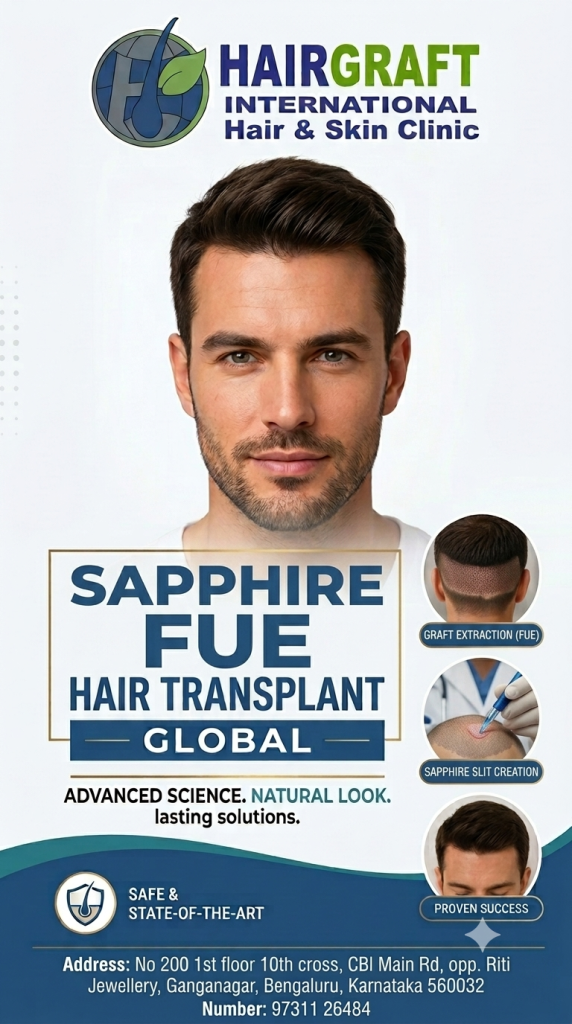
At Hairgraft International, Sapphire FUE is offered as an advanced variation of the FUE hair-transplant approach, using sapphire blades for creating recipient channels before the extracted follicles are implanted.
If you are considering a Sapphire FUE hair transplant in Bangalore, this guide explains what you can realistically expect before, during, and after the procedure.
What Is Sapphire FUE Hair Transplant?
Sapphire FUE is a variation of Follicular Unit Extraction (FUE).
In an FUE transplant, individual follicular units are carefully extracted from a donor area, generally from the back or sides of the scalp, and then transplanted into areas affected by thinning or baldness.
The word “Sapphire” refers primarily to the blade used to create the tiny recipient channels where the grafts will be placed. In other words, Sapphire FUE is not a completely separate form of hair transplantation; it is an FUE procedure that uses sapphire-tipped blades during the recipient-site creation stage.
At Hairgraft International, the technique is used as part of a personalized surgical hair-restoration plan. The objective is to create a hairline and density that fit naturally with the patient’s existing hair rather than simply placing as many grafts as possible.
Why Is Sapphire FUE So Popular?
There is a reason patients frequently ask about Sapphire FUE.
The recipient area is an important part of hair transplantation. The tiny channels need to be planned according to the direction, angle, spacing, and density of the patient’s natural hair.
Sapphire blades can be used to create precise recipient channels, which is one reason the technique is commonly promoted as a refined FUE approach. Hairgraft International describes its Sapphire FUE service as focusing on precise channel creation, graft placement, natural hair direction, and individualized density planning.
However, it is important to keep expectations realistic. The blade itself does not guarantee a particular result. Professional hair-restoration organizations and recent medical literature emphasize that factors such as surgical planning, graft handling, donor management, recipient-site design, and surgeon experience remain important. The ISHRS also notes that “Sapphire FUE” is a marketing/technical term rather than a separately recognized transplant category.
That is why, at Hairgraft International, the focus should be on the patient and the treatment plan—not simply the name of the technique.
How Does Sapphire FUE Hair Transplant Work?
A Sapphire FUE procedure involves several carefully planned stages.
1. Hair and Scalp Assessment
Before any procedure, the doctor examines your scalp, hair-loss pattern, existing density, donor area, and overall hair characteristics.
This stage is extremely important.
Not every person experiencing hair loss needs a transplant immediately. Some types of hair loss may benefit from medical treatment or non-surgical therapies instead.
For patients who may be suitable for transplantation, the donor area is assessed to determine whether sufficient healthy follicles are available.
2. Designing the Hairline
One of the most visible parts of a hair transplant is the hairline.
A hairline that is too straight, too low, too dense, or poorly aligned with the patient’s facial proportions can appear unnatural.
Therefore, hairline design should consider factors such as:
- Age
- Facial proportions
- Existing hairline
- Hair-loss pattern
- Donor availability
- Hair density
- Hair direction
- Long-term hair-loss progression
The goal is to create a hairline that looks appropriate not only immediately after transplantation but also as the patient ages.
3. Preparing the Donor Area
The donor area is usually located around the back and sides of the scalp.
This area is important because the follicles harvested from it are used to restore areas affected by hair loss.
During FUE, individual follicular units are extracted rather than removing a strip of scalp. FUE therefore does not create the linear scar associated with traditional strip harvesting, although small individual extraction scars can still occur.
4. Individual Graft Extraction
The surgeon carefully extracts individual follicular units from the donor area.
A follicular unit may contain one or several hairs.
Graft handling is extremely important because follicles are living tissue. They need to be protected from unnecessary trauma, dehydration, and damage during the procedure.
5. Creating Recipient Channels
This is where the Sapphire component becomes relevant.
Using sapphire blades, the surgeon creates tiny recipient channels in the areas where the follicles will be implanted.
The channels are planned according to the required:
- Direction
- Angle
- Depth
- Spacing
- Density
This step contributes to the final appearance because transplanted hair needs to emerge in a direction that blends naturally with surrounding hair.
6. Implanting the Grafts
The extracted grafts are then carefully placed into the recipient sites.
The surgeon works to distribute the follicles according to the planned design.
The front hairline may require finer, single-hair grafts to create a natural transition, while areas farther behind the hairline may require greater density.
This is why hair transplantation is not simply about “adding hair.” It is also an exercise in aesthetic design and follicular distribution.
Is Sapphire FUE Painful?
Sapphire FUE is performed using local anesthesia, so patients generally do not experience significant pain during the surgical portion of the procedure.
You may experience sensations such as pressure or movement during different stages.
After the procedure, some temporary tenderness, tightness, redness, swelling, or discomfort can occur.
Your doctor will provide appropriate post-operative instructions and explain how to care for both the donor and recipient areas.
Sapphire FUE Recovery: What Should You Expect?
Recovery differs between individuals, but most patients should expect a short period during which the scalp looks different from its normal appearance.
You may notice:
- Mild redness
- Small crusts around transplanted follicles
- Temporary swelling
- Tenderness
- Minor donor-area discomfort
The transplanted area should be handled carefully during the early recovery period.
Your clinic will advise you when to wash your hair, how to clean the scalp, when you can resume exercise, and when you can return to normal styling.
It is particularly important not to scratch, pick, or unnecessarily disturb the recipient area while it is healing.
When Does Hair Start Growing After Sapphire FUE?
This is one of the questions patients ask most often.
A hair transplant is not an overnight hair-growth treatment.
Some transplanted hairs may shed during the early months following the procedure. This can be part of the normal hair-growth cycle and does not automatically mean that the transplanted follicles have been lost.
New growth generally becomes noticeable after several months, with density developing gradually over time. Hairgraft International’s Sapphire FUE information notes that new growth may begin around 3–4 months, with further improvement occurring progressively.
The final appearance should be assessed over a longer period rather than judging the transplant during the first few weeks.
Patience is therefore an important part of the hair-transplant journey.
What Kind of Results Can You Expect?
The purpose of Sapphire FUE is to restore hair in areas affected by thinning or baldness while maintaining a natural appearance.
Potential treatment goals can include:
- Restoring a receding hairline
- Improving frontal density
- Filling temple areas
- Adding coverage to thinning regions
- Improving overall scalp coverage
- Creating a more balanced hairline
However, results vary between patients.
The number and quality of available donor follicles, the degree of hair loss, existing hair density, hair characteristics, medical factors, and surgical technique can all influence the final outcome.
No responsible clinic should promise an identical result for every patient.
At Hairgraft International, treatment planning is based on the individual’s scalp, donor area, hair-loss pattern, and restoration goals.
Who May Be Suitable for Sapphire FUE?
Sapphire FUE may be considered for people experiencing certain forms of pattern hair loss who have an adequate donor supply.
However, a consultation is necessary before deciding whether transplantation is appropriate.
A doctor may assess:
Your hair-loss pattern: Is the loss stable or progressing rapidly?
Your donor area: Are there enough healthy follicles available?
Your scalp condition: Is the scalp healthy enough for surgery?
Your expectations: Are your desired density and hairline realistically achievable?
Your long-term plan: How might your hair loss progress in the future?
This assessment helps prevent unrealistic expectations and unnecessary procedures.
Sapphire FUE vs Regular FUE
Patients often ask whether Sapphire FUE is completely different from conventional FUE.
The simplest way to understand it is:
FUE describes the follicular extraction method, while Sapphire FUE refers to the use of sapphire blades for recipient-site creation.
The donor follicles are still extracted individually using the principles of FUE.
The major distinction is therefore the instrument used during recipient-channel creation rather than an entirely different transplantation concept.
The important question is not simply “Is Sapphire better?”
A more useful question is:
“Which approach is appropriate for my scalp, donor area, hair-loss pattern, and desired result?”
That is something that should be answered during a professional consultation.
Why Choose Hairgraft International for Sapphire FUE in Bangalore?
At Hairgraft International Hair & Skin Clinic, Sapphire FUE is one of the surgical hair-restoration options available to patients in Bengaluru.
Our approach begins with understanding the individual rather than applying the same transplant plan to everyone.
The clinic’s hair-restoration services include FUE, FUT, Sapphire FUE, DHI, facial hair transplantation, female hair transplantation, long-hair transplantation, revision transplantation, and other hair-restoration options.
Hairgraft International states that its hair-transplant approach focuses on personalized planning, natural hairline design, appropriate density, and long-term hair restoration.
The clinic is located in Ganganagar, Bengaluru, at No. 200, 1st Floor, 10th Cross, CBI Main Road, opposite Riti Jewellery.
Book Your Sapphire FUE Consultation Today
If you’re considering a Sapphire FUE hair transplant in Bangalore, don’t choose a procedure based only on advertisements or package names. Start with a proper assessment of your hair loss and donor area.
At Hairgraft International Hair & Skin Clinic, our team can assess your current hair condition, discuss your goals, explain the available treatment options, and help you understand what kind of restoration may be realistically achievable.
📞 Call Hairgraft International: +91 95131 03103
📍 Hairgraft International Hair & Skin Clinic
No. 200, 1st Floor, 10th Cross, CBI Main Road, Opp. Riti Jewellery, Ganganagar, Bengaluru, Karnataka 560032.
Final Thoughts
Hair transplantation is a personal decision, and there is no single technique that is automatically suitable for everyone.
Sapphire FUE is an advanced variation of FUE that uses sapphire blades to create recipient channels, but the success of a hair restoration procedure depends on much more than the material of the blade. Careful diagnosis, realistic hairline design, donor management, precise graft extraction, appropriate recipient-site planning, careful implantation, and proper aftercare all contribute to the treatment journey.
For patients considering Sapphire FUE in Bangalore, the best place to start is a consultation.
At Hairgraft International Hair & Skin Clinic, the goal is to understand your hair loss first and then develop a treatment plan around your individual needs.
Your hair restoration journey should begin with the right diagnosis, the right plan, and realistic expectations.
Book your consultation with Hairgraft International today.